Heraldry Glossary – Heraldry made simple.
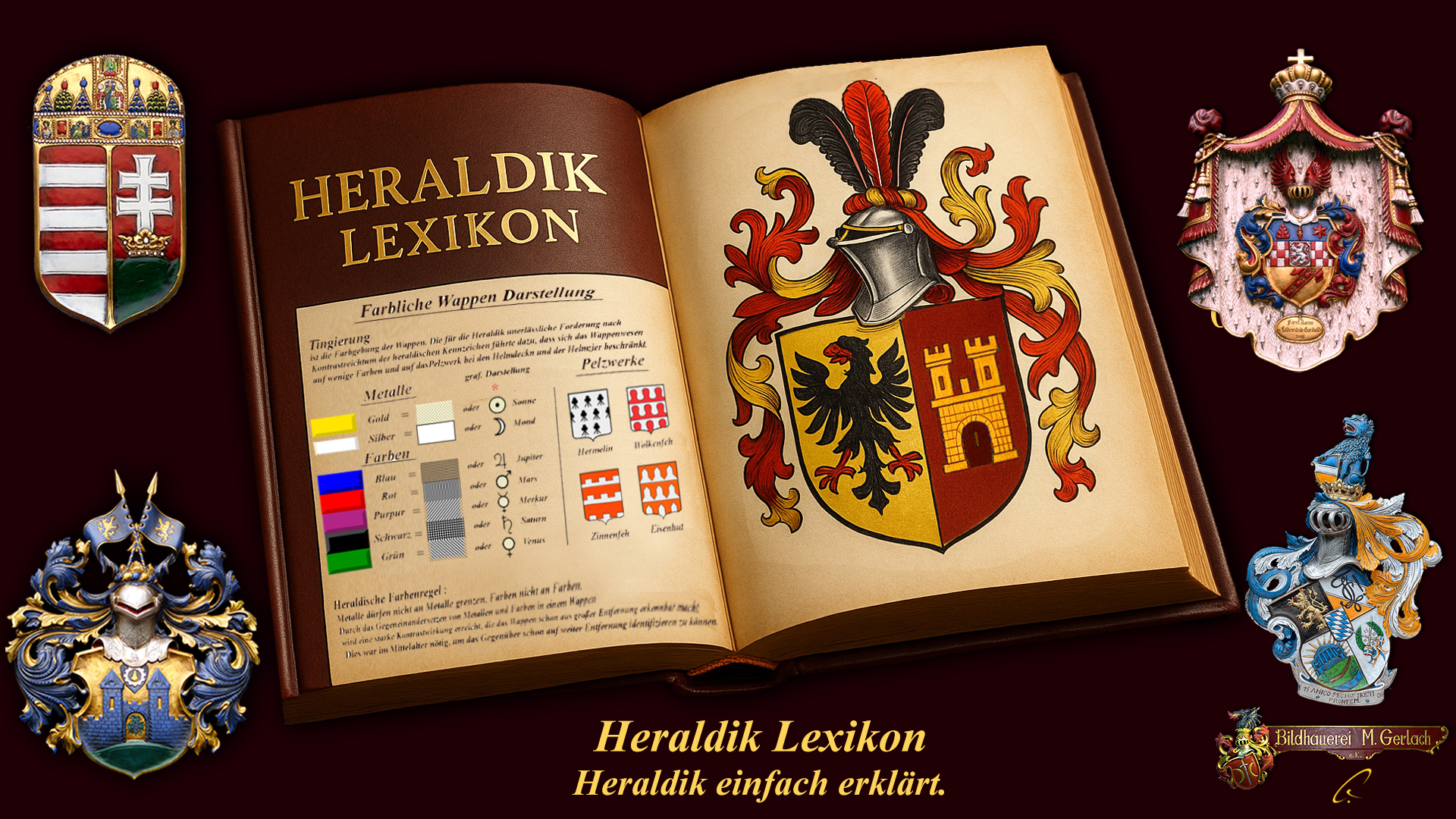
This Heraldry Glossary explains the most important terms of heraldry in a clear and accessible way, while remaining faithful to classical rules. It is aimed at everyone interested in family coats of arms, noble arms, municipal arms and fraternity arms – whether you already have a crest or are just getting started.
The explanations are written for readers without specialist training in heraldry, but they follow the principles of classical European heraldry. They do not replace scientific literature, but provide a solid foundation for understanding coats of arms and heraldry.
What is heraldry?
Heraldry is the study of coats of arms. It deals with the origin, structure, design, description (blazon) and history of arms. Originally, heraldry helped to identify knights and nobles on the battlefield and at tournaments. Today it plays an important role in family history, local history, genealogy and art history.
Structure of a classical coat of arms
A full heraldic achievement consists of several elements that form a unified composition. Depending on period, region and type of arms, some elements may be added or omitted, but the main parts are:
Basic heraldic terms – in brief
Tinctures: Heraldry distinguishes metals (gold = Or, silver = Argent), colors (red = Gules, blue = Azure, black = Sable, green = Vert, purple = Purpure), and furs (such as ermine and vair). A central rule is: no color on color, no metal on metal.
Ordinaries: simple geometric shapes such as fess, pale, cross, saltire, bend and similar elements that structure the field. In a blazon, ordinaries and divisions are mentioned first.
Divisions: ways of dividing the shield into fields, for example: per fess (horizontally), per pale (vertically), quarterly, per bend, and combinations of these.
Charges: all non-geometric figures – animals (lions, eagles, bears), plants (roses, oak leaves), objects (keys, swords, wheels), buildings (castles, towers) and many more. Charges often have symbolic meanings.
Blazon: the precise description of a coat of arms in heraldic language. A correct blazon should allow a heraldic artist to draw the arms without seeing the original illustration.
Types of coats of arms – who uses arms?
Over the centuries, different types of arms have developed, each associated with certain bearers:
How a new coat of arms is created
The design of a new coat of arms should always respect heraldic rules and avoid confusion with existing arms. In practice, the process often follows these steps:
In many countries, the use of a coat of arms is generally permitted, but a new design should be distinctive and must not deliberately imitate someone else’s arms.
Unauthorized use of another person’s arms may infringe name or trademark rights. For this reason, it is wise to have a new coat of arms checked by a heraldic expert and, if appropriate, registered in a recognized armorial. Binding legal advice, however, can only be given by a qualified legal professional.
Literature and sources on heraldry
Anyone wishing to study heraldry in more depth will find extensive information in heraldic literature and associations, for example:
Questions about heraldry or a hand-carved coat of arms?
If you have questions about designing a coat of arms or would like to commission a hand-carved wooden coat of arms, simply send me an email with a few details about the motif, size and intended location.
Master woodcarver Manfred Gerlach