


Ornament Lexicon – Decorative carving explained simply.
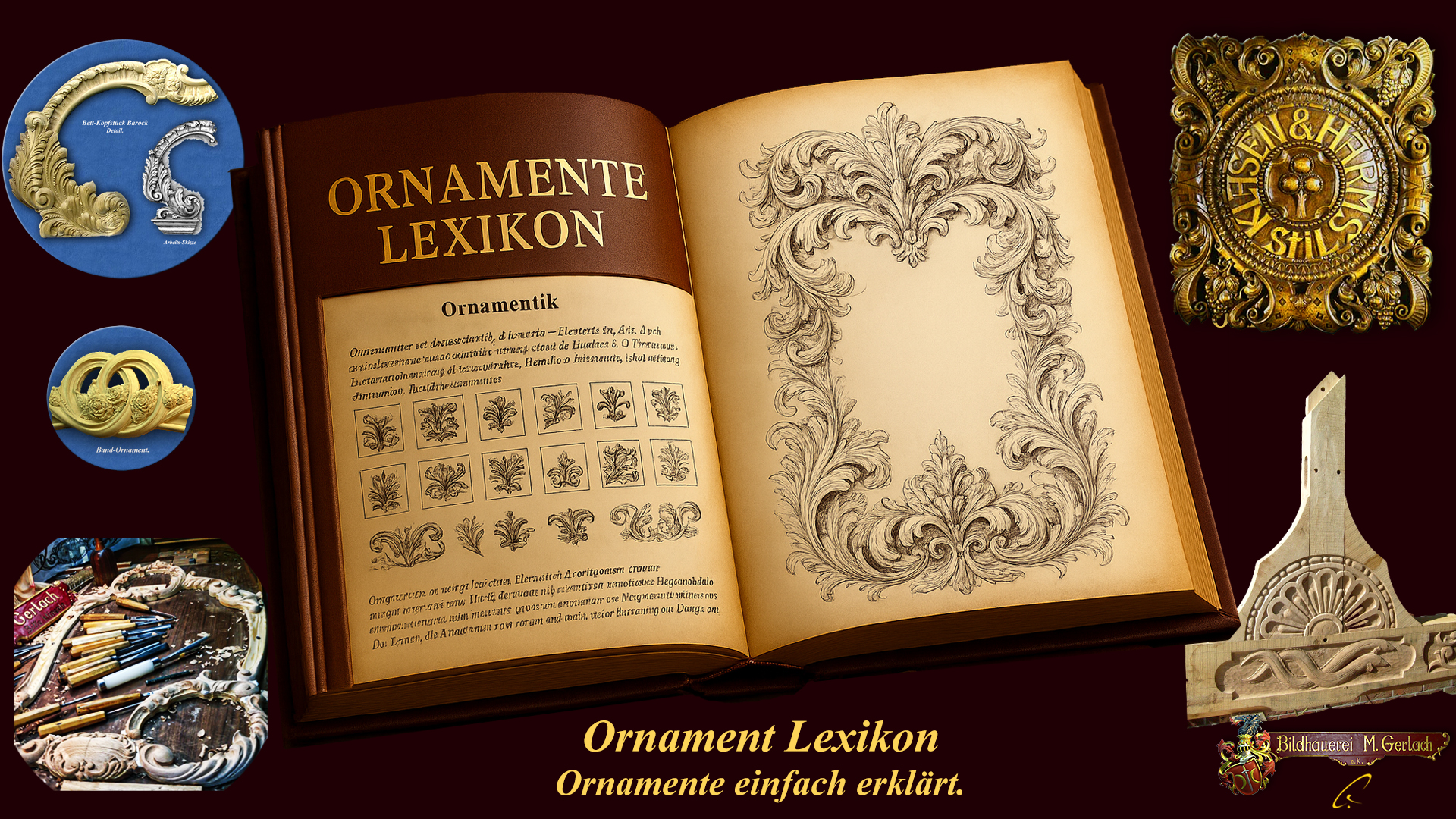
This Ornament Lexicon explains the most important terms related to style ornaments, furniture ornaments and architectural ornaments – easy to understand yet craft-accurate. It is for everyone who appreciates historic furniture, facades, doors or frames and would like to know what terms like acanthus, rocaille, volute or frieze actually mean.
The explanations follow European style history from the Romanesque period through to Neoclassicism. This is not meant to replace an academic textbook, but it will give you a solid foundation for recognising styles correctly and – in the case of restoration or a new commission – having ornaments reproduced in an appropriate manner.
What is an ornament?
An ornament is a deliberately designed decoration that embellishes surfaces, edges or architectural members without being a load-bearing element itself. Ornaments can be found on:
- Furniture (crowns, panel frames, mouldings, consoles)
- Facades (gable decoration, cornices, door and window crowns)
- Interiors (ceiling friezes, wall panels, altars, pulpits)
- Frames (mirrors, picture frames, home altars)
In wood carving, ornaments are created as plastic reliefs carved from the wood. Light and shadow make the forms come alive. Good ornaments are clearly composed, stylistically consistent and follow an inner logic of movement, counter-movement and points of rest.
Structure of a style ornament – key terms
Depending on the period, many shapes occur. Some basic terms appear again and again:
- Acanthus: leaf motif with strong, rolled lobes, typical of Renaissance, Baroque and Rococo.
- Volute: spiral/scroll form, often used on consoles, capitals and frame corners.
- Rocaille: shell-like, asymmetrical form, a core motif of Rococo.
- Cartouche: framed field, often used for coats of arms, monograms or inscriptions.
- Frieze: elongated decorative band dividing a piece horizontally.
- Cornice: projecting profile at the upper finish of furniture or facades.
- Console: supporting bracket in S-shape or volute form.
Key style periods in ornament design
Ornament design changed significantly over the centuries. Some of the most important European periods are:
Romanesque (c. 850–1250)
Features: bold block shapes, round arches, interlace, simple leaf forms.
Effect: massive, earthbound, archaic.
Gothic (c. 1230–1500)
Features: pointed arches, tracery, fine vines, long leaf tips.
Effect: upward-striving, openwork, filigree.
Renaissance (c. 1500–1620)
Features: clear structure, coffering, egg-and-dart, bead moulding, acanthus leaves.
Effect: calm, balanced, architecturally ordered.
Baroque (c. 1600–1730)
Features: strong movement, bold acanthus, sweeping S-curves, flowing transitions.
Effect: dramatic, rich, powerful.
Rococo (c. 1730–1780)
Features: rocaille forms, delicate leaf scrolls, asymmetrical sweeps.
Effect: light, playful, elegant.
Neoclassicism (c. 1770–1830)
Features: clear axes, garlands, laurel wreaths, antique-inspired motifs.
Effect: strict, calm, noble restraint.
Ornaments in practice and restoration
For restoration or replacement, it is crucial to match the original style and proportions. Typical tasks include:
- Replacing missing furniture ornaments (corners, panel frames, centre pieces)
- Carving new gable ornaments for timber-frame houses or front doors
- Creating frame ornaments for mirrors and pictures in the correct period
- Ornament work on sacred objects (altars, pulpits, devotional pieces)
In my workshop, such ornaments are carved as one-off pieces by hand – matched to the existing style, the wood species and the desired finish (natural, stained, painted or gilded).
Books and sources on ornament
If you would like to explore ornament design in more depth, you will find inspiration in:
- Textbooks on European furniture and architectural history
- Pattern books and historic ornament plates (Baroque, Rococo, Neoclassicism)
- Museums and collections of historic furniture and woodcarving
For practical information about commissioning and pricing hand-carved style ornaments, please see the page
Heraldry Lexicon • Coat of arms info
Master woodcarver Manfred Gerlach